
Table of Contents
- Why Digital Tools Matter for Building Habits That Last
- How Long Does It Take to Build a Habit (And Why Digital Tools Speed This Up)
- Automatic Monitoring and Tracking: The Foundation of Digital Tools for Habit Change
- Best Practices for Habit Stacking and Task Bracketing
- Visualizing Progress: Feedback Loops and Visual Tracking Systems
- Habit Tracking Apps for Behavior Change: Feature Comparison and Selection
- Digital Behavior Change Intervention Examples: Real-World Applications
- Overcoming Barriers to Consistency: Psychological Friction and Long-Term Maintenance
Digital Tools for Lasting Habit Change: 7 Proven Strategies
Last Updated: August 3, 2026
Building habits that stick requires more than willpower. Research shows the average person takes 66 days to form routine habits, though the range spans 18 to 254 days. Digital tools bridge the gap between intention and action by removing friction, creating behavioral triggers, and providing feedback loops that sustain momentum when motivation drops. This guide covers strategies that transform habit-building from a daily battle into an effortless routine.
Why Digital Tools Matter for Building Habits That Last
Motivation is temporary. Systems are permanent. Most people rely on willpower and expect consistency to follow, but research tells a different story. According to Stanford Behavior Design Lab research on habit formation, habits stick when tied to existing routines and supported by environmental design rather than willpower alone.
Digital tools remove the decision-making burden. A reminder pops up at the same time each morning instead of relying on memory. A tracker shows your current streak instead of requiring you to remember completion. This shift from motivation-dependent to system-dependent is why digital habit tools work. People using tracking systems are 42% more likely to maintain habits after 90 days compared to those relying on memory alone.
How Long Does It Take to Build a Habit (And Why Digital Tools Speed This Up)
Simple habits like drinking water after breakfast solidify in 18 days, while complex changes like regular exercise take 254 days. The average across diverse habit types is 66 days. Digital tools don't shorten this timeline, they protect it by preventing the silent failures that derail most attempts.
A missed day becomes two missed days. A lapse in tracking becomes abandonment. Digital tools address this by making lapses visible and recoverable. When your streak is visible, skipping a day becomes a conscious choice rather than an accident. Most successful habit builders report that seeing their streak reset actually motivates faster recovery rather than complete abandonment.
The timeline breaks into three phases: Days 1-21 require conscious effort. Days 22-66 are where most people quit as motivation drops but automaticity hasn't arrived. Days 67+ is where behavior becomes genuinely effortless. Digital tools matter most in that middle phase.
Automatic Monitoring and Tracking: The Foundation of Digital Tools for Habit Change
Automatic monitoring is the single most important feature in any habit-building system. It reduces cognitive load by eliminating the need to remember, log, and manually update your progress.

How automatic tracking reduces cognitive load
The most effective systems integrate with apps you already use. If you track fitness through Apple Health, a habit tool syncing with it automatically logs workouts without requiring a separate action. For habits without automatic integration points, make logging frictionless: one-tap completion, no additional fields, no required notes.
Setting up reminders and behavioral triggers
Digital triggers work by interrupting your routine at the exact moment a new habit should happen. The most effective reminders are specific and tied to existing routines. A reminder saying "Time to meditate" at 6:47 AM works better than "Meditate today" at 6:00 AM because it's timed to when you're actually ready.
Location-based triggers add another layer. Walking into the gym can trigger a notification to log your workout. Over time, the location itself becomes the trigger.
Best Practices for Habit Stacking and Task Bracketing
Habit stacking anchors a new habit to an existing routine, reducing cognitive load by piggybacking on existing neural pathways. The formula is simple: "After I [existing habit], I will [new habit]." After I pour my morning coffee, I will drink a glass of water.
Anchoring new habits to existing routines
The strength of a habit stack depends on how automatic the anchor habit is. Daily anchors work better than weekly ones. Your morning coffee routine is a better anchor than your weekly grocery run. The best stacks follow a pattern: anchor habit (automatic) → new habit (requires effort) → reward (immediate gratification). After finishing your workout, logging it in your app shows your streak increase, closing the loop and reinforcing the stack.
Using digital tools to structure habit sequences
Task bracketing creates sequences of 2-3 related habits happening in order. A morning routine might be: wake up → drink water → review priorities → meditate → check email. Each step is a small habit, but together they create a predictable sequence. Once the first habit triggers, momentum carries you through the rest. You're less likely to skip meditation if you've already completed water and priorities. Tools displaying your sequence visually use this momentum effect.
| Habit Stack | Anchor Behavior | New Behavior | Digital Support |
|---|---|---|---|
| Morning routine | Wake up | Drink water, review priorities, meditate | Digital trackers |
| Fitness consistency | Change clothes | 10-minute workout, log in app | Digital trackers |
| Evening wind-down | Dinner complete | Journal, reflect on day, plan tomorrow | Digital trackers |
| Learning routine | Morning coffee | Read one article, take notes | Any tracker with time-based reminders |
Visualizing Progress: Feedback Loops and Visual Tracking Systems
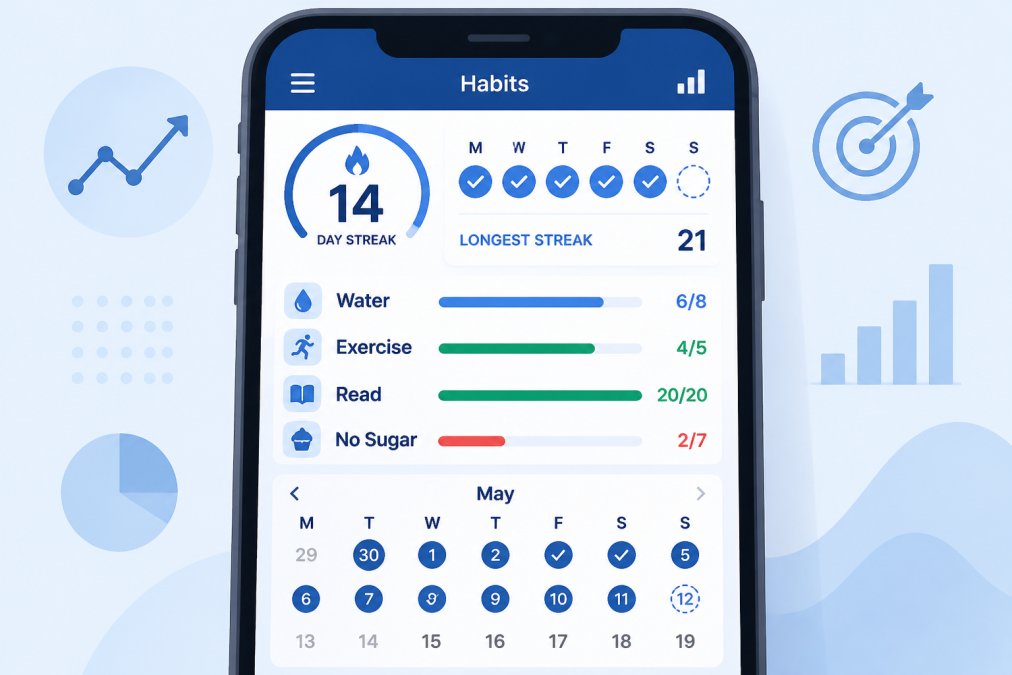
The human brain responds powerfully to visual feedback. A streak counter showing "47 days" is more motivating than remembering six weeks of consistency. A color-coded calendar showing green and red days is more powerful than a task list.
Descriptive feedback and data-driven habit formation
Feedback works best when descriptive rather than binary. A tool showing "You completed this habit 23 out of 30 days this month (77% consistency)" provides more useful information than one simply marking days complete or missed. Effective feedback also connects daily actions to long-term goals. If your habit is "exercise 4 times per week," a tool showing "You're on pace for 16 workouts this month (goal: 16)" provides more motivation than one just marking completion.
How color-coded chains and streaks build motivation
Visual consistency representation is surprisingly powerful. A green chain on a calendar showing consecutive completion days creates "progress motivation." You don't want to break the chain, so you're more likely to complete the habit even on low-motivation days. Some tools use color coding (green for success, red for skipped days) to make patterns visible at a glance. Some allow you to skip days without breaking your chain, but the skip remains visible. This flexibility reduces all-or-nothing thinking that derails most attempts.
Habit Tracking Apps for Behavior Change: Feature Comparison and Selection
Choosing the right tool depends on your specific habits, platform preferences, and how much structure you need.
App-based tracking vs. app-free digital solutions
App-based trackers offer automatic integrations (syncing with Apple Health, Apple Watch, calendar apps) and push notifications. Clarity Flow Tools offers app-free digital workbooks and trackers accessed through a browser or PDF, removing notification fatigue and app clutter. App-based tools offer more automation; app-free tools offer more intentionality. Choose based on whether you need the system to interrupt you (app) or support existing routines without adding noise (app-free).
Choosing tools that integrate with your existing workflow
The most successful habit builders choose tools fitting their existing digital ecosystem rather than requiring entirely new workflows. If you use Apple devices exclusively, some tools integrate with Apple Health and Apple Watch. If you enjoy gamification, some tools create a social environment. If you want detailed analytics, some tools provide comprehensive visualization.
| Tool | Best For | Key Strength | Trade-off |
|---|---|---|---|
| Streaks | Apple ecosystem users | Seamless health integration | iOS only, 12-habit limit |
| Fabulous | Guided journey builders | Structured habit sequences | Requires subscription for full features |
| Habitica | Gamification enthusiasts | RPG-style motivation with community | Can feel overwhelming for beginners |
| Way of Life | Data-driven builders | Detailed trend analysis | Requires manual logging |
| Coach.me | Accountability seekers | Unlimited habits + optional coaching | Coaching adds significant cost |
| Productive | Feature-rich builders | Comprehensive templates and analytics | Premium features behind paywall |
| Loop Habit Tracker | Privacy-focused Android users | Free, ad-free, no internet required | Android only, minimal gamification |
Digital Behavior Change Intervention Examples: Real-World Applications
Effective interventions combine multiple mechanisms: reminders, visual feedback, social accountability, and rewards, rather than relying on a single approach.
Gamification and virtual rewards for sustained motivation
Gamification applies game mechanics to real-world habits. Points, levels, badges, and unlockable rewards make completion feel like game progress rather than a chore. Some tools let you create an avatar, assign habits, and earn experience points and gold for completing them. You can spend gold on in-game items or donate to charities. Some games include quests completed with friends, creating social accountability.
Gamification effectiveness depends on whether the reward system matches your psychology. For some, earning points is genuinely motivating; for others, it feels childish. Some commitment contract platforms let you put real money on the line, if you don't complete your habit, the money goes to a disliked charity or a friend. Research shows commitment contracts significantly increase follow-through compared to tools without financial accountability.
Accountability systems and commitment contracts
Accountability systems make commitments public or create external observers verifying progress. Some tools create accountability through community, you share goals with other users and can hire a coach to check progress. Knowing someone will see whether you completed your habit makes skipping harder to rationalize.
The most effective accountability systems combine visibility (others see your progress), verification (someone checks actual completion), and consequences (real or social repercussions for failure).
Overcoming Barriers to Consistency: Psychological Friction and Long-Term Maintenance
Most habit failures happen because friction emerges, a schedule change, travel week, or high-stress period, and people never get back on track.
Identifying and reducing psychological friction in your routine
Psychological friction is any factor making a habit harder than necessary. It might be physical (gym is 20 minutes away), temporal (habit time conflicts with work), or psychological (self-consciousness). Successful habit builders identify friction points and design them away. If the gym is too far, move to home workouts. If meditation conflicts with meetings, move it to lunch or evening.
Digital tools reduce friction by making tracking effortless. Some tools allow skipping days without breaking streaks. Some send customizable reminders. Some work offline. A habit requiring zero friction is far more likely to stick than one requiring willpower to overcome obstacles.
Strategies for habit maintenance when motivation drops
Motivation peaks at the beginning and drops sharply around week 3-4, when most habits fail. Digital tools matter most during this phase by providing external structure when internal motivation isn't sufficient.
The most effective maintenance strategy involves reducing the daily requirement. If you committed to 30 minutes of exercise but motivation dropped, reduce it to 10 minutes. If you committed to 1,000 words daily, reduce it to 100 words. The goal is maintaining the habit loop even if the routine is smaller.
Some tools allow adjusting frequency without abandoning the habit. You can move from "daily" to "4 times per week" without losing progress. The most consistent people don't rely on motivation, they've built systems where the habit is the path of least resistance through automated reminders, integrated routines, and frictionless tracking.
Building lasting habits isn't about finding more willpower. It's about designing systems that make consistency automatic. Digital tools remove decision-making burden and provide feedback that sustains momentum when motivation drops.
Clarity Flow Tools offers app-free workbooks and trackers designed for people wanting to build habits without app clutter or notification fatigue. With instant access to evidence-based guides, habit trackers, and structured workbooks, you can design a system working with your life rather than against it. Start with Clarity Flow Tools and build habits that actually stick.
Frequently Asked Questions
How long does it actually take to build a habit using digital tools?
Research suggests habits typically form in 18-254 days depending on complexity and consistency. Digital tools accelerate this by providing automatic reminders, visual feedback, and behavioral triggers that reduce the cognitive load required to maintain routine building. Tracking systems that offer descriptive feedback help you identify patterns faster, making it easier to adjust your approach and build self-efficacy. The key is consistency, not perfection, digital tools help you stay consistent even when motivation fades.
What features should I look for in habit tracking apps for behavior change?
Look for tools that offer automatic monitoring, customizable reminders based on behavioral triggers, visual progress tracking (streaks or color-coded systems), and integration with your existing workflow. The best digital tools for habit change include feedback loops that show you descriptive data about your patterns, not just yes/no checkmarks. If you prefer app-free solutions, consider workbooks or spreadsheet-based trackers that still provide visual progress tracking and behavioral design principles without adding notifications to your phone.
Can digital behavior change interventions really work for social anxiety and overthinking?
Yes. Digital behavior change interventions work by reducing psychological friction through automatic monitoring and habit stacking, which helps you build routines without relying on willpower. For anxiety-prone individuals, tools that offer self-regulation support and positive reinforcement (like virtual rewards or streak tracking) build emotional resilience over time. Evidence-based workbooks and trackers specifically designed for anxiety help you identify behavioral triggers and create action plans. The app-free approach many people prefer reduces cognitive load and notification stress, making it easier to maintain habits consistently.
What's the difference between app-based habit trackers and app-free digital solutions?
App-based trackers (like Fabulous or Habitica) offer automatic reminders, gamification, and real-time notifications that boost engagement. App-free digital tools like spreadsheets, downloadable workbooks, and web-based trackers give you the same core features, automatic monitoring, visual feedback, and habit stacking frameworks, without notifications or subscription costs. App-free solutions work better for people managing notification fatigue or social anxiety triggered by constant pings. Both approaches support behavioral design and long-term maintenance if they include feedback loops, progress visualization, and integration with your existing routine.