
Table of Contents
- Why Growth Guides Matter for Your Business
- Business Growth Strategies for Startups: Where to Start
- Growth Hacking Templates That Drive Real Results
- Business Growth Tools for Entrepreneurs: Building Your Stack
- Leadership Development Resources to Scale Your Team
- How to Choose Growth Guides That Actually Stick
- Common Mistakes When Implementing Growth Strategies
- Conclusion
Last Updated: August 11, 2026
Why Growth Guides Matter for Your Business
Growth guides are structured resources designed to help you build scalable systems, develop leadership capabilities, and execute proven strategies without reinventing the wheel. They distill years of real-world experience into actionable frameworks you can implement immediately.
The difference between businesses that scale and those that stall often comes down to one thing: access to the right knowledge at the right time. When you're startup growth, leadership development, or team scaling, having a clear roadmap cuts months off your learning curve. That's what growth guides do, they compress decades of collective experience into step-by-step systems you can actually follow.
At Clarity Flow Tools, we've found that teams using structured growth guides see faster progress because they're working from proven playbooks rather than guessing. The guides address the specific challenges you face: customer acquisition, team scaling, revenue optimization, and sustainable growth.
The real value isn't just information, it's permission to stop overthinking and start executing. Many entrepreneurs waste months researching before taking action. Growth guides eliminate that friction by providing frameworks tested across hundreds of implementations.
Business Growth Strategies for Startups: Where to Start
Starting a business means juggling dozens of priorities simultaneously. The most successful startups don't try to do everything at once, they focus on a specific growth lever, master it, then move to the next one.
Your first growth strategy should target customer acquisition through your most defensible channel. For most startups, this is either direct outreach, content marketing, or referrals, not paid advertising. Paid channels require capital you probably don't have yet, and organic channels compound over time.
Here's what separates startups that gain traction from those that don't: they pick ONE acquisition channel, commit fully for 90 days, and measure ruthlessly. They don't split effort across email, social media, and paid ads simultaneously. That approach guarantees mediocre results everywhere.
The second critical business growth strategy is product-market fit validation. Before scaling, confirm that customers actually want what you're building and will pay for it. This means talking to 20-50 potential customers, listening for consistent pain points, and iterating based on feedback, not vanity metrics.
Leadership development matters even at the early stage. As the founder, your ability to make decisions quickly and delegate effectively determines how fast your team can move. This is where many startups fail, the founder becomes the bottleneck because they haven't developed the leadership skills to trust others with critical decisions.
Growth Hacking Templates That Drive Real Results
Growth hacking templates aren't about tricks or manipulation, they're about systematizing the actions that move the needle. A well-designed template removes decision fatigue and ensures your team executes consistently.
Email sequence templates are foundational. When you have a framework for onboarding emails, re-engagement sequences, and win-back campaigns, your team stops debating what to send and starts measuring what works. The template becomes your starting point, not your ceiling. You test variations, track results, and iterate.
Sales follow-up templates work similarly. Consistent follow-up is what converts prospects into customers, but most teams follow up inconsistently because there's no system. A template ensures every lead gets touched at the right intervals with the right message.
Conversion rate optimization templates help you identify bottlenecks in your funnel. Rather than guessing where prospects drop off, a structured audit template walks you through each stage, identifies friction points, and suggests specific tests. This is where growth hacking becomes measurable, you're not chasing vanity metrics, you're optimizing for the actions that drive revenue.
The most effective growth hacking templates include three components: a clear process, specific metrics to track, and decision rules for what to do based on results. Without decision rules, you collect data but don't act on it. With them, you systematize improvement.

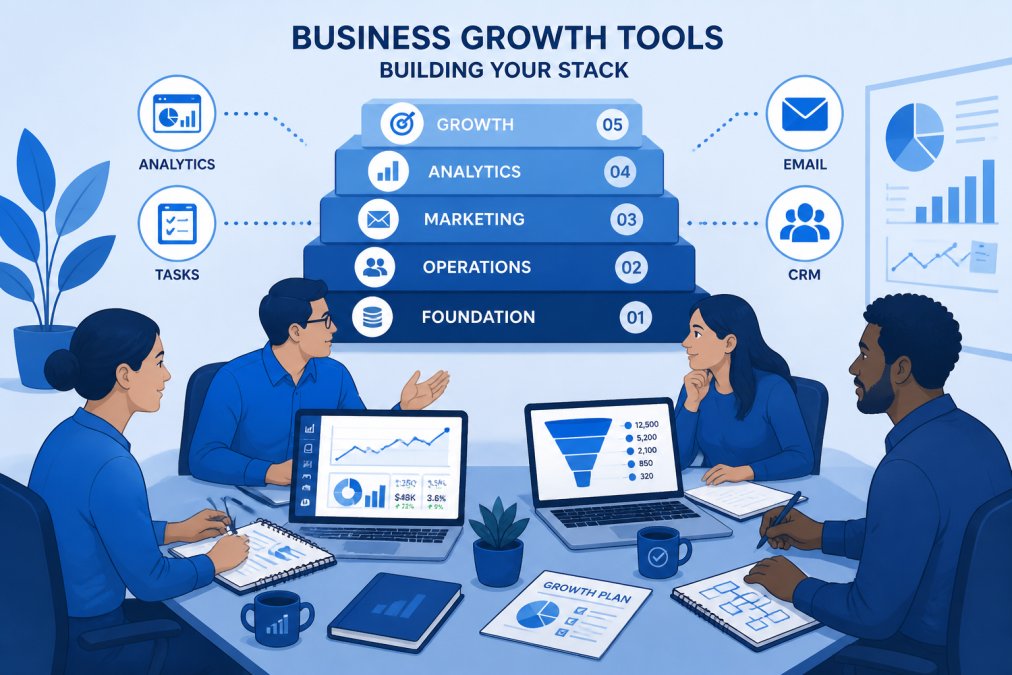
Business Growth Tools for Entrepreneurs: Building Your Stack
Your toolkit should solve specific problems without creating complexity. Many entrepreneurs accumulate tools until they're managing ten different platforms, defeating the purpose of having tools at all.
Start with three core tools: an email marketing platform, a CRM or simple customer database, and an analytics tool. These three handle customer acquisition, customer management, and measurement. Everything else is secondary.
Email marketing platforms like HubSpot (which offers a free resources library alongside its software) and Reforge (which provides in-depth growth programs and frameworks) help you stay in contact with prospects and customers systematically. The platform handles delivery, segmentation, and tracking, functions you absolutely cannot do manually at scale.
A CRM system tracks every customer interaction in one place. This prevents the chaos of prospects falling through cracks because information lives in scattered emails and spreadsheets. Even a simple spreadsheet with structured fields beats a disorganized email inbox.
Analytics tools measure what's actually working. Without clear measurement, you're guessing. Google Analytics gives you free website traffic data. From there, you can decide whether you need more specialized tools.
The mistake most entrepreneurs make is buying tools before they have the volume to need them. You don't need sophisticated automation when you have 20 customers. You need it when you have 200 and can't manually manage relationships anymore.
| Tool Type | Primary Use | When You Need It |
|---|---|---|
| Email Platform | Customer communication & automation | 50+ regular contacts |
| CRM System | Prospect & customer tracking | 20+ active opportunities |
| Analytics Tool | Performance measurement | Consistent traffic or sales |
| Project Management | Team coordination | 3+ team members |
| Content Platform | Publishing & distribution | Weekly content creation |
Leadership Development Resources to Scale Your Team
As your business grows, your ability to develop leaders becomes your competitive advantage. The founder who can't delegate stays the bottleneck. The founder who builds strong leaders scales exponentially.
Leadership development isn't about sending people to seminars. It's about creating systems where people get feedback, practice new skills, and see results. This happens through regular one-on-ones, clear expectations, and permission to fail safely.
Reforge offers programs specifically designed for professionals seeking to develop leadership skills and accelerate growth strategies. LinkedIn Learning provides video courses taught by industry experts on management and leadership topics. These platforms work best when your team has time to engage with them, which means you need to build learning into your weekly schedule, not treat it as optional.
The most effective leadership development approach combines three elements: self-directed learning (your team chooses resources relevant to their role), peer learning (team members teach each other), and structured feedback (regular conversations about what's working and what needs improvement).
Many teams skip this entirely because it feels like a luxury. It's actually your highest-use investment. A strong leader multiplies the output of everyone they manage. A weak leader creates chaos and turnover.
How to Choose Growth Guides That Actually Stick
Not all growth guides are created equal. Some are theoretical frameworks that sound smart but don't translate to action. Others are so specific to one company's situation that they don't apply to yours. The best guides are practical, adaptable, and built on real results.
When evaluating growth guides, look for three characteristics: specificity, actionability, and evidence. A guide that says "improve your marketing" is useless. A guide that says "send three follow-up emails at days 1, 3, and 7 to increase conversion by 15%" is actionable because you know exactly what to do and what to expect.
Evidence matters because it proves the approach works beyond the author's situation. If a guide claims a strategy works but provides no evidence, you're taking a bet. If it includes case studies, metrics, or data from multiple implementations, you're working from proof.
The most common mistake is choosing guides based on the author's reputation rather than the content's quality. A famous entrepreneur's guide might be interesting but not practical for your specific situation. A lesser-known guide built by practitioners solving your exact problem is more valuable.
Implementation is where most guides fail. You buy the guide, read it once, and then it sits in a folder. The guides that stick are the ones you return to repeatedly because they're structured for action, not just reading. Look for guides that include templates, checklists, or worksheets, not just theory.
Clarity Flow Tools specializes in practical, evidence-based digital systems designed to help you implement consistently. The guides, workbooks, and trackers are structured for action, they're not meant to be read once and forgotten. They're built to support ongoing implementation with habit-building tools and progress tracking.
Common Mistakes When Implementing Growth Strategies
Implementation failure is the most common reason growth strategies don't work. You have the right framework but execute it inconsistently. You start strong but abandon it after three weeks. You implement halfway and wonder why results don't match expectations.
The first mistake is treating growth strategies as one-time initiatives instead of ongoing systems. You implement a new email sequence, see some results, and assume you're done. Real growth comes from continuous iteration, testing variations, measuring results, and improving systematically. One email sequence that works is just your starting point.
The second mistake is measuring too early. Most strategies need 30-90 days to show real results. If you abandon an approach after two weeks because you don't see immediate traction, you'll never build momentum. Set a minimum timeframe (90 days is standard), commit to that, then evaluate.
The third mistake is poor documentation. When you don't document what you're doing, why you're doing it, and what results you're measuring, your team can't execute consistently. New team members can't follow the process. You can't improve what you haven't documented.
The fourth mistake is overcomplicating implementation. You read a guide about advanced growth strategies and try to implement five tactics simultaneously. Your team gets overwhelmed, execution becomes sloppy, and nothing works well. Pick one tactic, master it, then add the next one.
The fifth mistake is ignoring context. A strategy that works for a B2B SaaS company might not work for a B2C e-commerce business. The best growth guides acknowledge these differences and help you adapt frameworks to your situation instead of applying them rigidly.
Many teams also fail because they don't assign clear ownership. Everyone's responsible for growth means nobody's responsible. Assign one person to drive each growth initiative, give them the authority to make decisions, and hold them accountable for results.
Implementing growth guides successfully requires two things: choosing frameworks built for action and committing to consistent execution over time. Clarity Flow Tools provides practical, evidence-based systems designed specifically for this, instant access to guides, workbooks, and tracking tools that keep you consistent without relying on motivation alone. The framework is clear, the templates are ready to use, and the habit-building approach ensures you actually follow through. Get started with Clarity Flow Tools and build the scalable growth systems that move your business forward.
Frequently Asked Questions
How do growth guides differ from traditional business coaching?
Growth guides provide structured, self-paced frameworks you work through independently, while coaching typically involves one-on-one or group sessions with a coach. Guides offer instant access to actionable systems and templates you can implement immediately, making them ideal if you prefer learning at your own pace without recurring costs. Coaching works better if you need personalized feedback and accountability. Many people combine both, using guides for foundational strategies and coaching for specific challenges.
What metrics should you track when implementing growth guide strategies?
Focus on metrics tied to your specific goal: customer acquisition cost, conversion rate, email subscriber growth, customer lifetime value, and revenue per channel. Track where your traffic comes from and which marketing channels drive the highest-quality leads. For team growth, monitor hiring velocity and employee retention. The key is measuring inputs (what you're doing) and outputs (results), then adjusting your approach based on what the data shows. Most growth guides include frameworks for identifying which metrics matter most to your business.
Can growth guides really help if I've tried other resources before without success?
Yes, if the issue wasn't the content but how you used it. Most people abandon resources because they're overwhelming, generic, or lack accountability. Growth guides work better when they're specific to your situation, provide step-by-step systems rather than theory, and include templates you can use immediately. The difference is actionability, guides with checklists, trackers, and workbooks you fill out create momentum. Start by choosing one guide focused on your biggest bottleneck, not trying to implement everything at once.
Are there growth guides designed specifically for introverts or people with social anxiety?
Yes. Resources exist that address communication anxiety, networking without draining your energy, and building confidence in professional settings. Look for guides that focus on written communication, one-on-one conversations, and asynchronous collaboration, these play to introvert strengths. Guides emphasizing preparation, structured frameworks, and small-group interactions work better than those assuming comfort with large networking events. The right guide acknowledges that different personality types need different strategies for the same outcome.