
Table of Contents
- How Mindfulness Calms Social Anxiety
- Grounding Techniques for Social Anxiety That Work in Real Time
- How to Practice Mindfulness in Public Without Anyone Noticing
- Daily Mindfulness Habits for Introverts: Build Consistency Without Willpower
-
5 Mindfulness Exercises for Social Anxiety You Can Do Anywhere
- 1. Box breathing (4-4-4-4), for the two minutes before you walk in
- 2. The observer stance, for when thoughts are loud
- 3. Single-point focus, for when your eyes are darting
- 4. Body scan on the go, for the tension you didn't notice
- 5. Mindful listening, for the middle of a conversation
- The mistake that undoes all five
- A note on what these exercises are not
- Mindfulness for Digital and Virtual Social Anxiety
- When Mindfulness Isn't Enough: Integrating Professional Therapy
- Frequently Asked Questions
Last Updated: September 26, 2026
How Mindfulness Calms Social Anxiety
Mindfulness exercises for social anxiety work by interrupting the cycle of anxious thoughts before they spiral. Simple, repeatable practices can help people stay present in conversations instead of getting trapped in their heads.
Social anxiety disorder affects millions of adults, and the racing thoughts that come with it often start with self-referential processing: the brain turning every interaction into a referendum on your worth.
Grounding Techniques for Social Anxiety That Work in Real Time
Grounding techniques pull your attention out of your head and into your body. The goal is not to eliminate anxiety. It's to give your nervous system something concrete to hold onto while the fight-or-flight response settles. Most ranking articles describe grounding as a concept; what they skip is the moment-by-moment script you actually run while someone is talking to you.
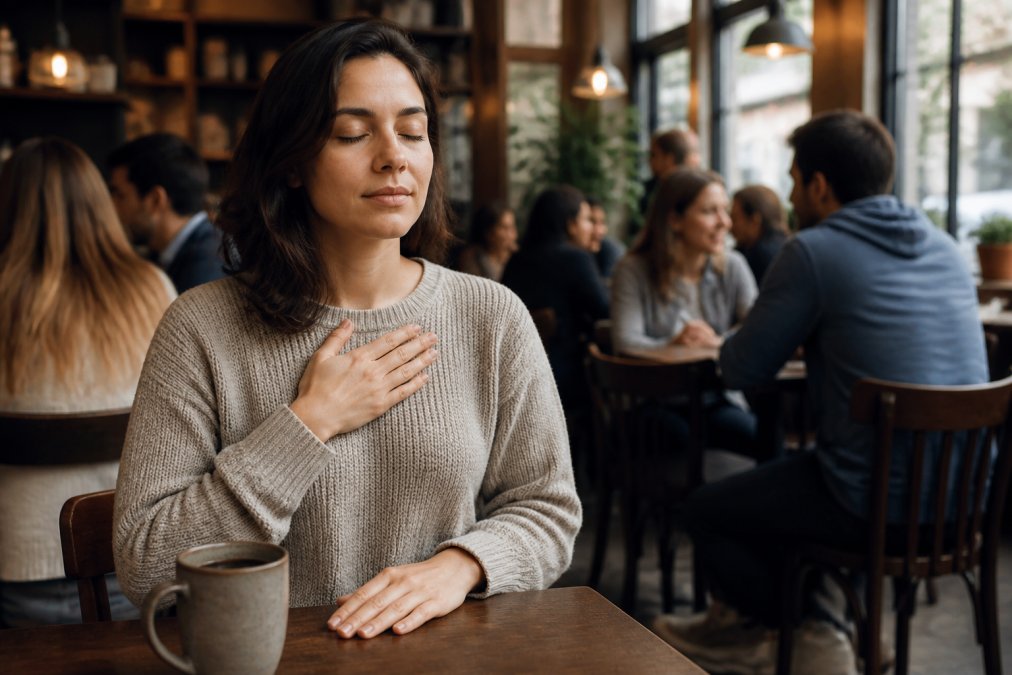
The 5-4-3-2-1 method, with a real-time script
The 5-4-3-2-1 method is the most portable grounding exercise for social anxiety: name five things you see, four you hear, three you can touch, two you can smell, and one you can taste. It takes about 60 seconds and no one around you notices. Here's how it sounds in your head during an actual conversation:
- See (5): "Blue mug. Window light. Her gray sweater. The plant on the sill. My own hands."
- Hear (4): "Her voice. The espresso machine. A chair scraping. My own breath."
- Touch (3): "Chair back against my spine. Sleeve on my forearm. Floor under both feet."
- Smell (2): "Coffee. Clean laundry."
- Taste (1): "The last sip of water."
Why grounding works on the nervous system
Grounding works because anxiety lives in the future, the imagined judgment, the anticipated awkward silence, while your senses only report the present. When you deliberately route attention to sight, sound, and touch, you're competing for the same limited attentional resources the anxious thoughts were using. Lengthening your exhale at the same time nudges the parasympathetic branch of the nervous system, which is the part responsible for the calm-down response.
The 3-second reset for active conversations
When you're mid-sentence and feel the flush of anxiety, you don't have 60 seconds. You have about three. Use this micro-sequence:
- Press both feet into the floor. Feel the pressure. That's one anchor.
- Drop your shoulders a quarter inch. Anxiety pulls them up toward your ears before you notice.
- Take one slow exhale through your nose, longer than the inhale. Don't force a deep breath in, that can spike the sensation of panic. Just make the out-breath longer than the in-breath.
A common mistake: waiting for the peak
A common mistake is waiting until panic peaks to try grounding. By then, your heart rate and breathing are already elevated, and the technique feels like it isn't working. Practice during calm moments first, in line at the grocery store, waiting for a meeting to start, sitting in traffic, so the technique is automatic when you actually need it.
What to do when grounding doesn't work
Sometimes grounding doesn't land. Your mind keeps returning to the anxious thought, or the physical sensations are too loud to override. That's not failure, it's information. Two options:
- Switch anchors. If body-based grounding isn't working, try external grounding: pick one object in the room and describe it in detail to yourself (color, shape, texture, what it's made of). External focus is often easier when internal sensations are overwhelming.
- Name it and let it be. Say silently, "This is anxiety. It's uncomfortable and it will pass." You're not fighting the feeling; you're labeling it, which research on affect labeling suggests can reduce its intensity.
Practicing in the wild
Grounding is a skill, not a switch. The people who report it working during real social situations are the ones who ran it dozens of times when nothing was at stake. Pick one low-stakes moment today, a phone call, a checkout line, a walk past a neighbor, and run the 5-4-3-2-1 sequence once.
How to Practice Mindfulness in Public Without Anyone Noticing
Learning how to practice mindfulness in public comes down to choosing techniques that don't look like techniques. No one needs to know you're running a mental exercise while they talk about their weekend.
Here's what works discreetly:
- Anchor on your feet. Feel both soles against the floor. Shift weight slowly.
- Count breaths silently. In for four, out for six. Keep your face relaxed.
- Notice one sensory detail. The temperature of your drink, the texture of your sleeve.
- Soften your jaw. Anxiety clenches it before you realize it.
- Name the thought, then release it. "That's a worried thought." Move on.
Daily Mindfulness Habits for Introverts: Build Consistency Without Willpower
For overthinkers, a short evening practice helps close the loop on rumination. Write down one worry, then one thing that went fine. This builds cognitive reappraisal over time.
5 Mindfulness Exercises for Social Anxiety You Can Do Anywhere
These five exercises cover the situations where social anxiety hits hardest: before a meeting, during a conversation, and in the spiral afterward. Each one is written as a script you can run silently, without anyone around you noticing. These techniques are often listed; here's what they actually look like in practice.
1. Box breathing (4-4-4-4), for the two minutes before you walk in
Inhale for four counts, hold for four, exhale for four, hold for four. Repeat for two minutes. Use it in the car, in the hallway, or in the bathroom stall before walking into a room.
2. The observer stance, for when thoughts are loud
Watch your thoughts like cars passing on a road. You're on the sidewalk, not in any of the cars. When a thought arrives, "They think I'm boring", you note it and let it drive past.
3. Single-point focus, for when your eyes are darting
Pick one object in the room, a painting, a plant, the rim of your glass, and study it for 30 seconds. Notice its color, its edges, the way light hits it. Then return your attention to the conversation.
4. Body scan on the go, for the tension you didn't notice
Move your attention from the top of your head to the soles of your feet, releasing tension as you go. You can do this in 60 seconds without closing your eyes.
5. Mindful listening, for the middle of a conversation
During conversation, focus fully on the other person's words instead of rehearsing your reply. When you notice yourself planning what to say next, bring your attention back to what they're actually saying.
The mistake that undoes all five
A common mistake is treating these as emergency tools only. If you only pull out box breathing when you're already panicking, it won't feel like it works. Use them daily, during a calm phone call, while waiting for coffee, on a walk, so they become second nature. These exercises can be more effective in real social situations for those who have practiced them when nothing was at stake.
A note on what these exercises are not
These are not a cure for social anxiety disorder. They are tools that reduce the intensity of anxiety in the moment so you can stay in the situation instead of avoiding it. Avoidance is what keeps social anxiety alive; staying present, even uncomfortably, is what teaches your nervous system that the situation is survivable.
Mindfulness for Digital and Virtual Social Anxiety
Virtual meetings create a specific kind of anxiety that in-person advice doesn't cover. The camera, the mute button, and the chat window all add layers of self-monitoring.
When Mindfulness Isn't Enough: Integrating Professional Therapy
Mindfulness is a tool, not a cure. If social anxiety interferes with work, relationships, or daily functioning, professional support matters.
American Psychological Association resource on anxiety treatment
Frequently Asked Questions
What is the 3-3-3 rule in mindfulness?
The 3-3-3 rule is a quick grounding technique: name three things you can see, three sounds you can hear, and three body parts you can feel. It pulls your attention away from anxious thoughts and into the present moment. You can use it anywhere, and it takes less than a minute. For social anxiety, it works well right before you enter a room or when you feel your mind starting to race during a conversation.
How does mindfulness help reduce social anxiety symptoms?
Mindfulness reduces social anxiety by training you to observe anxious thoughts without judgment, which weakens rumination and self-referential processing. It also activates the parasympathetic nervous system through breathing regulation, lowering physiological arousal like a racing heart or sweaty palms. Research shows that consistent practice improves emotional regulation and attentional control, making it easier to stay present in conversations instead of getting caught in an internal monologue about how you're being perceived.
What are quick mindfulness exercises for social situations?
Try the 3-3-3 rule, a one-minute breath count (inhale for four, hold for four, exhale for six), or mindful listening, where you focus entirely on the other person's words instead of planning your reply. You can also do a body scan in your chair, noticing where tension sits and releasing it. These take under two minutes and can be done without anyone noticing, making them practical for meetings, parties, or phone calls.
How long does it take to see results from mindfulness practice?
Many people notice a small shift in anxiety within two to three weeks of daily practice, though significant changes in how you respond to social triggers typically take six to eight weeks. The key is consistency, not duration. Five minutes every day works better than a one-hour session once a week. Pairing mindfulness with a structured tool, like a habit tracker or workbook, helps you stay on track when motivation dips.
Social anxiety doesn't disappear because you read the right article. It fades when you practice the right skills, consistently, in real situations. That's where Clarity Flow Tools comes in. Our evidence-based workbooks and habit trackers give you a simple, app-free system for building mindfulness into your daily life, so you stay consistent without relying on motivation. Get started with Clarity Flow Tools and turn small daily practices into lasting calm.