
Table of Contents
- Why Self-Help Workbooks Are Better: Active Learning vs. Passive Consumption
- The Implementation Gap: Why Passive Reading Fails
- How to Use a Self-Help Workbook Effectively
- How Long to Spend on a Self-Help Workbook for Real Results
- Self-Help Books vs. Workbooks: What the Science Shows
- The Neuroscience of Tactile Learning and Knowledge Retention
- Building Accountability Structures Into Your Workbook Practice
- Workbooks for Anxiety, Social Confidence, and Overthinking
Last Updated: August 13, 2026
Why Self-Help Workbooks Are Better: Active Learning vs. Passive Consumption
Reading a self-help book feels productive, but understanding something intellectually is not the same as implementing it. This is the core problem that explains why self-help workbooks are better than books alone. A workbook forces active engagement with frameworks, writing answers about your specific situation, and creating a record of your own thinking. This shift from passive reading to active learning is the difference between a book gathering dust on your shelf and a tool that genuinely reshapes how you approach anxiety, social interactions, or the patterns that keep you stuck.
The Implementation Gap: Why Passive Reading Fails
Most self-help books assume that understanding a concept is the same as being able to apply it. You can read about cognitive behavioral therapy techniques for managing anxious thoughts and still freeze when anxiety hits in a real conversation. Passive reading doesn't bridge this gap because it doesn't demand anything from you.
The problem compounds because reading feels like progress. Your brain gets a dopamine hit from consuming information, creating the illusion of forward movement. Two weeks later, you're back in the same anxious pattern because you never actually practiced anything.
Workbooks interrupt this cycle by refusing to let you stay passive. Every page asks you to engage with your own situation, not a hypothetical one. This active engagement is where behavioral change actually begins.
How to Use a Self-Help Workbook Effectively
The difference between someone who gets results from a workbook and someone who abandons it comes down to approach.

Step 1: Set a Specific Behavioral Goal Before You Start
Don't open a workbook hoping it will help you feel better generally. Identify a specific behavior or situation you want to change: reducing anxiety in social situations, speaking up in meetings, or stopping overthinking before decisions. When you have a specific goal, the workbook's exercises transform from abstract practice into directly applicable training.
Step 2: Complete Exercises With Real Situations, Not Hypotheticals
Use the actual situation you're trying to improve, not a vague scenario. If you're working through social anxiety, write about the real conversation you're dreading next week. If you're managing overthinking patterns, apply the framework to the decision you're actually struggling with. Real situations are harder to work through, but that resistance is exactly where growth happens.
Step 3: Track Progress Through Written Reflection
After completing an exercise, spend five minutes writing about what shifted. Did your perspective change? What's one thing you'll do differently? This reflection transforms a completed exercise into a data point about your own growth and creates accountability to yourself.
How Long to Spend on a Self-Help Workbook for Real Results
Most effective workbook engagement happens in 15-30 minute sessions, three to four times per week. Trying to power through a workbook in marathon sessions doesn't work because your brain needs time to process and apply what you're learning.
The real timeline for seeing results is 4-8 weeks of consistent engagement. This is longer than the motivation-fueled excitement of week one, but it's the window where behavioral patterns actually start shifting. Those who commit to consistent, moderate engagement for two months consistently report noticeable shifts in how they handle anxiety, social situations, or overthinking patterns.
Self-Help Books vs. Workbooks: What the Science Shows
The difference between books and workbooks maps onto how learning and behavioral change actually work in the brain.
Why Books Leave the Implementation Gap Unfilled
A traditional self-help book activates different neural pathways than doing. Your brain is in consumption mode, not application mode. You're building declarative knowledge (facts and concepts), but not procedural knowledge (what you need to actually change your behavior). This gap explains why you can read about managing social anxiety and still feel paralyzed before a networking event.
Books are also designed for understanding without immediate feedback. You read about a technique but don't test it against your own situation, so you don't know if it works for you. Six months after finishing a book, you're likely to forget most of what you read because you never encoded it through active practice.
How Workbooks Close the Gap Between Knowledge and Action
A workbook forces active learning from the first exercise. When you write out your thoughts in response to a workbook prompt, you're engaging multiple neural systems: language processing, memory retrieval, emotional processing, and decision-making. This richer engagement creates stronger neural pathways than passive reading alone.
Workbooks also provide immediate feedback through self-reflection. You complete an exercise and immediately notice whether the framework helps you understand your situation better. The written record creates a reference point you can return to, providing tangible evidence of progress that sustains motivation.
The Neuroscience of Tactile Learning and Knowledge Retention
When you handwrite an answer to a workbook prompt, you're activating motor cortex regions, sensory regions, and language regions. This multisensory engagement creates a richer neural representation than reading alone.
Handwriting also slows you down in a useful way, forcing you to be more deliberate about what you're writing. This deliberation is where deeper processing happens. The physical act of marking up a workbook creates what researchers call "elaborative encoding", you're actively organizing material, connecting it to your own thoughts, and making decisions about what matters. This organizational process creates durable memories and usable knowledge.
Building Accountability Structures Into Your Workbook Practice
One of the biggest obstacles to sustained workbook engagement is the lack of external accountability. Simple structures work: tell a friend what workbook you're doing and when you'll check in; set a recurring calendar reminder and treat it like an appointment; track which exercises you've completed and review your progress weekly.
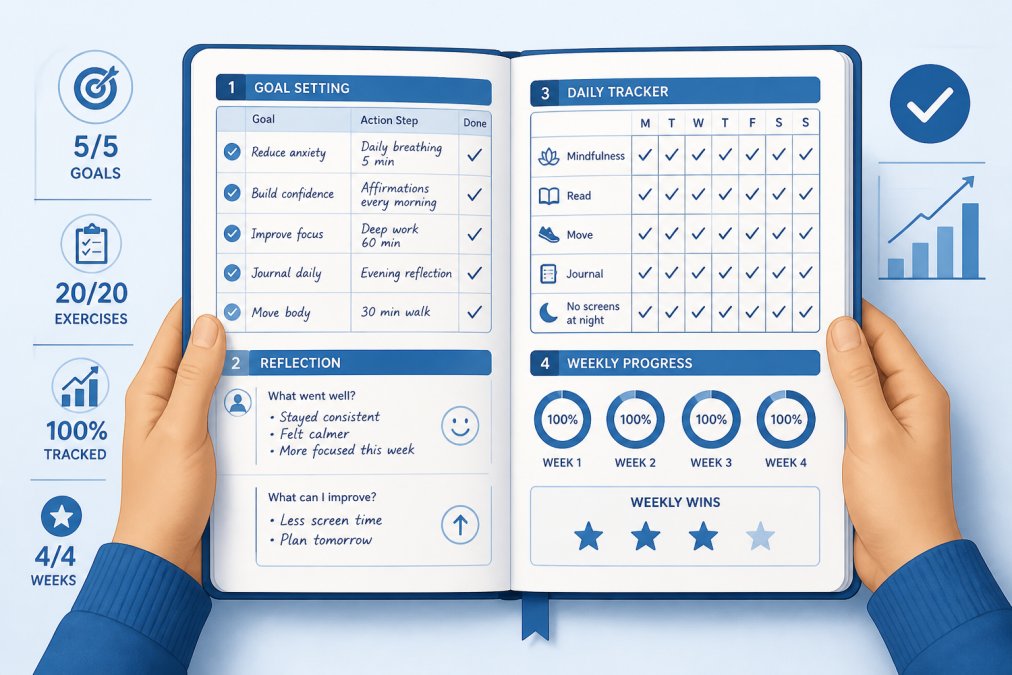
Choose an accountability structure that matches how you actually operate. If you respond to social pressure, tell a friend. If you're motivated by seeing progress, create a visual tracker. If you need external structure, schedule your workbook time like a therapy appointment and protect that time fiercely.
Workbooks for Anxiety, Social Confidence, and Overthinking
The benefits of workbooks are especially pronounced for anxiety, social confidence, and overthinking. These patterns are deeply ingrained, requiring practice to shift, not just understanding.
For anxiety, a workbook lets you practice cognitive techniques in the context of your actual anxious situations. For social confidence, you practice skills on paper first, working through the specific scenarios you find challenging. This low-stakes practice builds confidence before you enter the actual situation.
Overthinking responds powerfully to workbook-based practice because workbooks are specifically designed to interrupt and redirect thinking patterns. Writing forces you to slow down the overthinking loop and see it more clearly.
Self-help books can inform you; they can't transform you. Workbooks bridge the implementation gap by demanding active engagement, providing a record of your progress, and creating the practice environment where behavioral change actually takes root. If you've tried self-help books and found yourself back in the same patterns weeks later, it's not because the ideas don't work, it's because reading about change isn't the same as practicing it. Workbooks fix that fundamental problem by making practice unavoidable and progress visible.
Frequently Asked Questions
Are self-help workbooks actually more effective than self-help books?
Yes. Self-help workbooks outperform traditional books because they require active engagement through written exercises, self-reflection, and behavioral practice. Books deliver information; workbooks transform that information into actionable change. The difference lies in the implementation gap, readers often finish books without applying the concepts, while workbooks force application during the learning process itself. This active learning approach produces measurable behavioral change and lasting anxiety reduction.
How long should I spend on a self-help workbook to see real results?
Most evidence-based workbooks require 4-8 weeks of consistent engagement to produce noticeable results. The key is consistency over intensity, spending 15-30 minutes daily on exercises is more effective than marathon sessions. For anxiety and social confidence workbooks specifically, you'll typically notice shifts in your thought patterns within 2-3 weeks and behavioral changes within 4-6 weeks. Long-term retention and habit formation take longer, typically 8-12 weeks of regular practice to solidify new mental models and responses.
Can a self-help workbook replace therapy for anxiety or social anxiety?
Workbooks are powerful for managing mild to moderate anxiety and building confidence, but they're not a substitute for professional therapy in cases of severe anxiety, panic disorders, or trauma. However, many therapists recommend workbooks as complementary tools between sessions or after therapy ends. For overthinkers and people with social anxiety in specific situations, evidence-based workbooks provide structured, self-paced practice that builds lasting confidence without the cost or scheduling constraints of ongoing therapy.
What makes workbooks different from regular self-help books?
Workbooks combine education with interactive exercises, journaling prompts, and behavioral practice. Unlike books that explain concepts, workbooks require you to apply those concepts to your own life through written reflection and real-world experimentation. This tactile, active learning process engages different neural pathways, improving knowledge retention and habit formation. Workbooks also create an accountability structure, the act of writing your thoughts and tracking progress increases follow-through and prevents the abandonment that often happens with passive reading.